
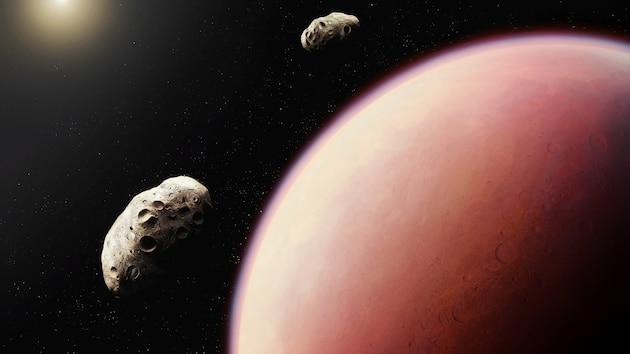
We’ve learned a lot about Mars since Mariner 4 took the first close-up photos of the red planet in 1965. Since that mission, orbiters, landers and rovers have explored the Martian surface, expanding our understanding of the planet.
But we know very little about Mars’ moons, Phobos and Deimos, including how they formed.
Japan Aerospace Exploration Agency’s (JAXA) Martian Moons eXploration (MMX) mission could unlock some of the moons’ mysteries and help scientists better understand Mars’ history and our own planet.
“MMX will be the first spacecraft ever to return to Earth from the Mars system,” said Tom Statler, NASA’s MMX program executive and scientist, during a pre-launch press conference. “The Phobos samples will be historic. The first samples from a moon other than Earth’s moon,” he added.
Scheduled to lift off as early as Monday, Oct. 19, at 3:41 p.m. EDT from the JAXA Tanegashima Space Center, MMX is a first-of-its-kind mission that will not only study the moons of Mars but bring samples back to Earth.
Led by JAXA in partnership with NASA, the European Space Agency, and the French and German space agencies, the orbiter will arrive at Mars in August 2027, then turn its attention to Phobos a month later. NASA says MMX won’t technically orbit the moon; instead, it will use a “quasi-satellite orbit,” circling Mars in a path that keeps it near Phobos.
MMX is equipped with 13 scientific instruments, including NASA’s MEGANE instrument, which, the agency says, “will let MMX ‘see’ the elemental composition of the moon’s surface and help peg the likely origin of the moon.”
After studying Phobos from space, MMX will then attempt one or two landings on the Martian moon’s surface. The spacecraft is expected to spend two to two and a half hours on the ground during each stop. While there, it will use a device called a Pneumatic Sampler to collect at least 10 grams of soil from Phobos. MMX will then deliver that material back to Earth in 2031, depositing it in Australia by using a capsule designed to survive re-entry into our planet’s atmosphere.
“It will help us better understand Phobos and the evolution of the Mars system. The mission’s science and return samples will complement decades of Mars exploration and help inform future discoveries, and perhaps even in the further future, crewed missions to the red planet,” said Lindsay Hays, NASA’s acting director of the Planetary Science Division.
Scientists have long speculated on the origins of Mars’ moons. They may have started as asteroids that Mars pulled into its orbit. Or they could be debris remnants flung into orbit after a giant object struck the Martian surface. The challenge is that there’s compelling evidence for both possibilities. By studying the samples collected on Phobos, scientists believe they can finally solve that question.
“By going to the Martian moons, studying them up close and bringing samples back to Earth we’ll be able to determine whether Phobos material is more consistent with an asteroid composition or with debris created by a collision involving Mars. That’s the kind of question that we need to have instruments right there at the object and have the detailed laboratory analysis of the actual material to answer,” explained Statler.
Why does it matter how Mars’ moons came to be? Statler said that knowing where the moons came from can reveal how the solar system, and our own planet, took shape.
“For years, we’ve been asking questions like, ‘Well, how did water get delivered to the Earth? Did the same processes deliver water to Mars, to Venus, to Mercury? Where did organic materials come from, and so on,'” said Statler. “Understanding where Phobos and Deimos came from goes to understanding what was going on at that time and where that stuff was coming from.”
The spacecraft won’t land on Mars because, unlike Phobos, the red planet has an atmosphere and significantly more gravity. This makes landings and liftoffs much more challenging and would require a different kind of vehicle. But that doesn’t mean the mission won’t return Martian samples to Earth because of Phobos’s proximity to Mars.
“That proximity to Mars means that it is conceivable that meteor impacts on Mars, large ones, can blast material up off the surface of Mars and some of that can find its way to Phobos,” said Statler. “The general consensus is there is a very good chance that there is a tiny fraction of Mars material mixed in with the regolith, the soil, on the surface of Phobos.”
If even a trace of Mars is mixed into the Phobos soil, it would be an unexpected bonus: a mission aimed at Mars’ moons could end up delivering a piece of Mars itself. NASA will receive at least 15% of the returned samples for the scientific community to analyze. What they’ll find remains to be seen, but it could raise new questions about Mars’ history and the formation of our solar system.
“It’s a piece of the puzzle that will enable us to ask smarter questions about how to explore and where to explore,” Statler said.
Copyright © 2026, ABC Audio. All rights reserved.
